Let’s be honest for a second. Counting calories can sometimes feel like trying to solve a complicated math equation before you’ve even had your morning coffee. But when it comes to healthy eating, understanding what makes up those calories is just as important as the number itself.
Enter finger millet—commonly known as Ragi in India.
Finger millet has been a staple in Asian and African diets for thousands of years. Recently, it has exploded in popularity across the globe. Why? Because it is a nutritional powerhouse. But if you are watching your waistline or trying to optimize your daily diet, you probably have one big question: How many calories are in finger millet, and how do they actually affect my body?
At Mekitt.com, our mission is to make millet nutrition information easier to understand for everyday users. We want to bridge the gap by presenting well-researched information in simple language.
Let’s dive into the caloric profile of finger millet, break down its nutritional science, and figure out exactly what it means for your daily diet.
What Exactly is Finger Millet?
Before we talk numbers, let’s set the stage. Finger millet (Eleusine coracana) is an annual grass grown primarily in arid and semi-arid regions. It gets its name from the appearance of its seedhead, which looks a bit like a hand with fingers.
Unlike refined grains that lose most of their nutrients during processing, finger millet is typically consumed in its whole form. This means you eat the bran, the germ, and the endosperm. You get all the fiber, all the vitamins, and all the minerals nature intended.
The Caloric Breakdown of Finger Millet
When you look at the raw data, finger millet looks fairly similar to other grains in terms of pure energy.
According to general nutritional databases like the USDA FoodData Central, a standard 100-gram serving of raw finger millet contains approximately:
- Calories: 328 to 336 kcal
- Carbohydrates: 72 grams
- Protein: 7.3 grams
- Fat: 1.3 grams
- Dietary Fiber: 11.2 grams
Note: Nutritional values can fluctuate slightly based on soil quality and farming methods, but these averages provide a highly accurate baseline.
Raw vs. Cooked Calories: The Water Factor
Here is a common trap people fall into when tracking macros: mixing up raw and cooked weights.
When you cook finger millet (usually by boiling it into a porridge or mixing it with hot water to make dough), it absorbs a massive amount of water. Water has zero calories.
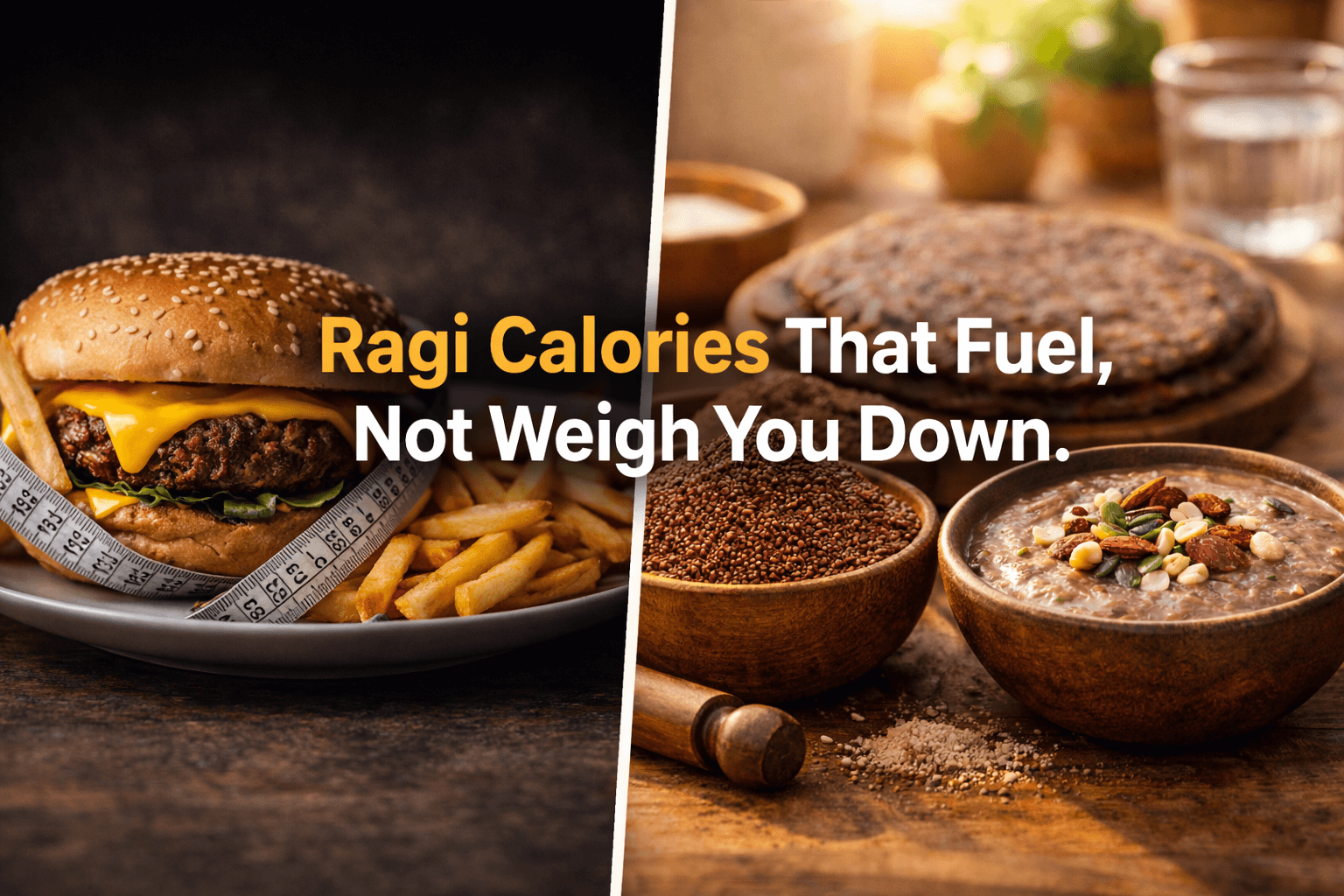
Therefore, 100 grams of cooked finger millet porridge will have significantly fewer calories than 100 grams of raw flour. A standard bowl of cooked ragi malt (using about 30 grams of flour and water) usually clocks in at around 100 to 110 calories. That makes it an incredibly low-calorie, high-volume meal that keeps you full for hours.
Are the Calories in Finger Millet “Good” Calories?
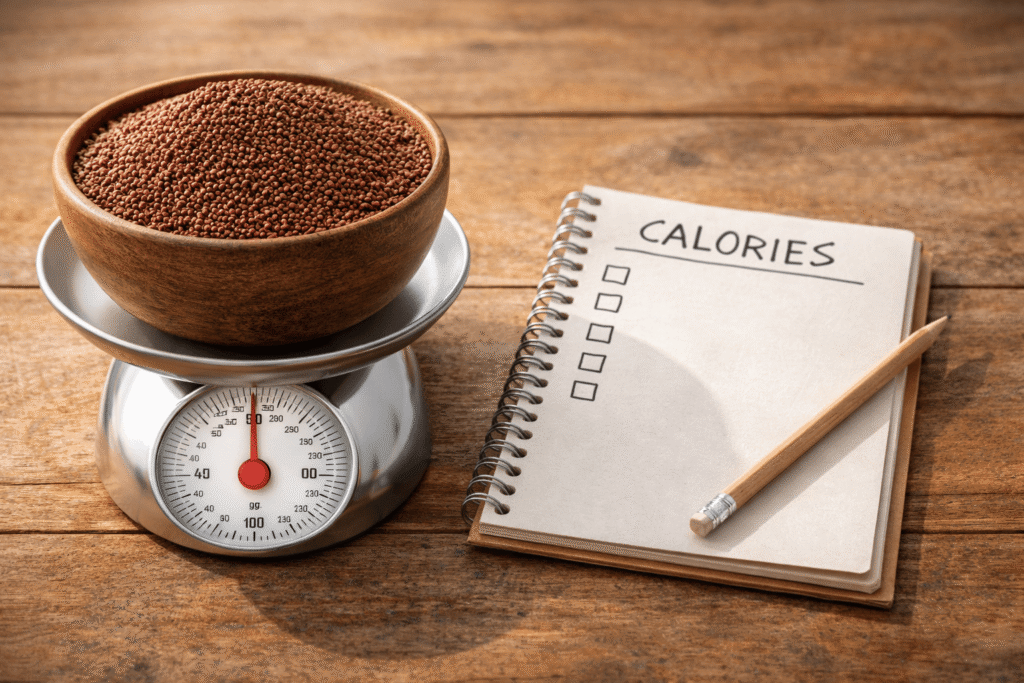
Not all calories are created equal. Drinking 300 calories of soda impacts your body very differently than eating 300 calories of whole grains.
Finger millet provides what nutritionists call “nutrient-dense” calories. Let’s look at why these calories work in your favor.
1. Complex Carbohydrates and Low Glycemic Index
Finger millet is packed with complex carbohydrates. Your body takes a long time to break these down. Instead of dumping sugar into your bloodstream all at once, ragi releases glucose slowly and steadily.
Because of this slow digestion, finger millet has a relatively low Glycemic Index (GI). This steady release of energy prevents the dreaded mid-afternoon sugar crash and helps keep your energy levels stable throughout the day.
2. High Dietary Fiber
With over 11 grams of fiber per 100 grams, finger millet is a digestion champion. Fiber adds bulk to your diet without adding digestible calories. It sweeps through your digestive tract, promoting gut health and preventing constipation.
More importantly for your daily diet, fiber triggers satiety. It tells your brain, “Hey, we are full!” This makes you less likely to overeat later in the day.
3. A Calcium Powerhouse
Here is a mind-blowing fact: Finger millet contains more calcium than any other cereal or grain.
Clocking in at roughly 344 milligrams of calcium per 100 grams, it rivals dairy products. If you are lactose intolerant or follow a vegan diet, the calories you get from ragi do double duty by protecting your bone density and supporting muscle function.
You can read more about the importance of dietary calcium on trusted platforms like the National Institutes of Health (NIH).
What This Means for Your Daily Diet
Understanding the calories in finger millet is great, but applying that knowledge is where the magic happens. Here is how you can use this super-grain to hit your daily nutritional goals.
For Weight Management
If your goal is to lose weight, finger millet is your best friend. Even though it is calorie-dense in its raw form, its high fiber content means you naturally eat less of it.
Replacing a refined grain (like white rice or all-purpose flour) with finger millet flour reduces your overall caloric intake over the day. The amino acid Tryptophan present in ragi also helps curb your appetite.
For Muscle Building and Fitness Enthusiasts
While ragi is not as high in protein as a chicken breast, it provides a respectable 7.3 grams of plant-based protein per 100 grams. Furthermore, it contains vital amino acids like valine, threonine, and isoleucine, which assist in muscle repair.
Athletes often use ragi malt as a pre-workout drink because it delivers sustained energy without causing bloating.
For Managing Blood Sugar
The calories in finger millet are highly recommended for individuals managing diabetes. Because of its high polyphenol content and dietary fiber, it helps control sudden spikes in blood sugar. Naturally, you should always monitor your portion sizes, but as a carbohydrate source, it ranks among the safest and most beneficial.
Practical Ways to Add Finger Millet to Your Routine
You don’t need to completely overhaul your diet to enjoy the benefits of finger millet. Start small and incorporate it smartly.
- Morning Ragi Malt: Mix two tablespoons of sprouted ragi flour with hot water, a splash of milk (or almond milk), and a pinch of cardamom. It’s a warm, comforting, 100-calorie breakfast that rivals any expensive oat latte.
- Ragi Roti: Swap out your regular wheat flatbreads for ragi rotis. They are slightly denser, beautifully earthy in flavor, and pair perfectly with spicy curries.
- Healthy Baking: You can substitute 30% of the refined flour in your pancake, muffin, or cookie recipes with finger millet flour. It adds a nutty flavor and significantly boosts the nutritional profile of your treats.
The Sprouting Secret: Unlocking More Nutrients
If you want to get the absolute most out of your finger millet calories, try sprouting it.
Like many grains, ragi contains phytic acid, which is an anti-nutrient that can block your body from absorbing minerals like iron and zinc. When you soak and sprout finger millet, you neutralize the phytic acid.
Sprouting also increases the bioavailability of vitamin C and makes the grain much easier to digest. Many health experts consider sprouted ragi flour to be a true nutritional goldmine.
Transparency and Medical Responsibility
We pride ourselves on providing accurate, research-backed information. We focus on accuracy over assumptions and user safety over shortcuts.
However, we want to be completely transparent: this website is run by a single individual, not a medical team. The content provided here is strictly for educational purposes. It does not replace the advice of professional nutritionists or healthcare experts.
If you have specific dietary restrictions, metabolic conditions, or personal medical concerns, we strongly advise you to consult a qualified healthcare professional before making drastic changes to your diet. My role is simply to research, summarize, and explain this information accurately—not to diagnose or treat.
Final Thoughts: Should You Count Ragi Calories?
Yes and no.
If you track your macros rigorously, you should absolutely account for the 328 calories per 100g of raw finger millet. But if you take a more holistic approach to eating, you don’t need to stress over the exact caloric math.
The calories in finger millet bring along a heavy payload of fiber, calcium, iron, and slow-release energy. They build your bones, satisfy your stomach, and fuel your day. In the grand scheme of your daily diet, adding finger millet is one of the smartest, most logical nutritional choices you can make.