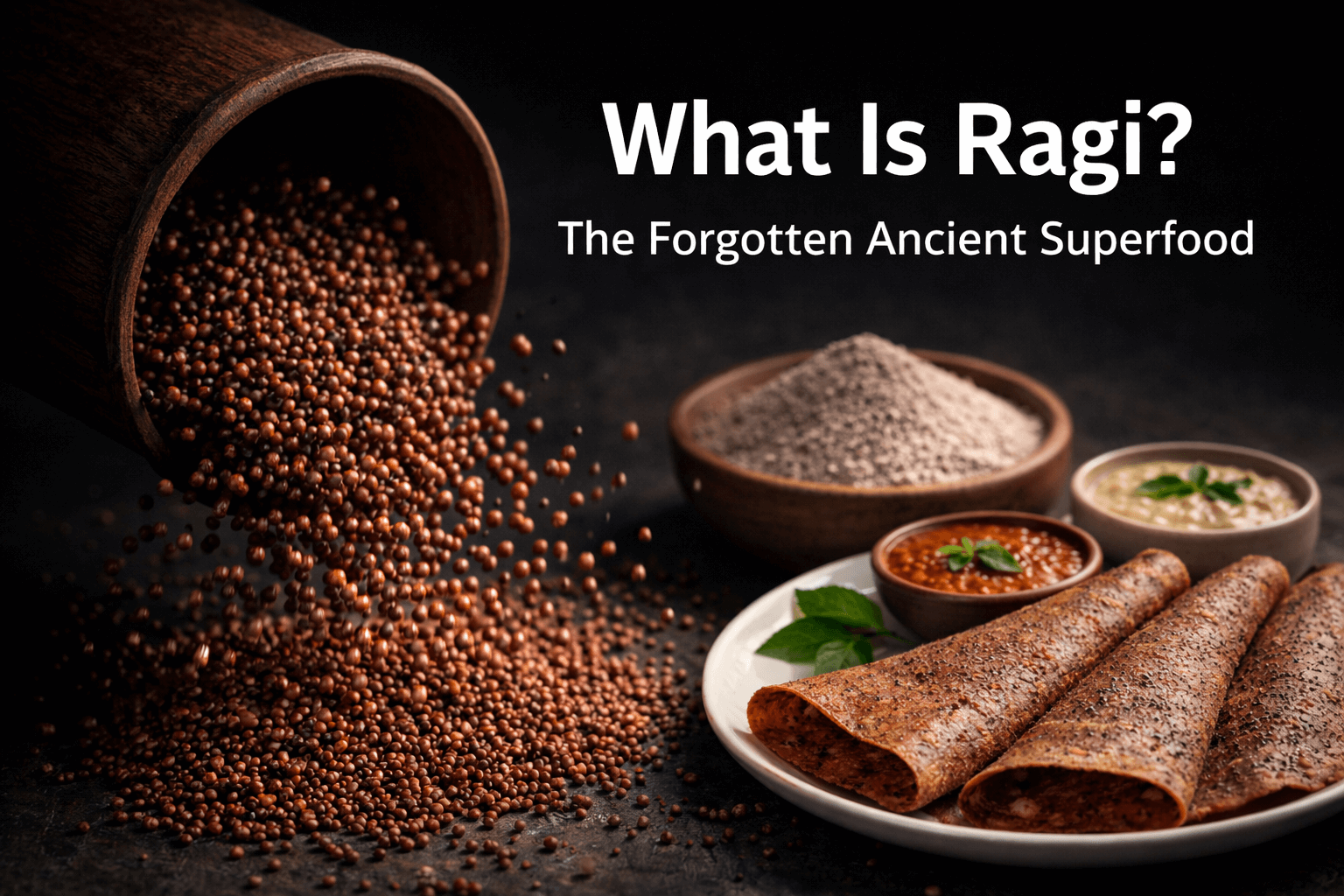
Let’s be honest for a second. If you grew up in a South Indian household, you probably have a complicated relationship with Ragi. Maybe you were the kid who was chased around the kitchen with a bowl of “sludge” (aka Ragi Malt) while your grandmother listed off a hundred reasons why it would make you stronger than Superman.
If you didn’t grow up with it, you might be staring at this reddish-brown flour in the supermarket aisle, wondering, “Is this just dirt? Or is this the superfood everyone on Instagram is raving about?”
Well, spoiler alert: Grandma was right.
Welcome to the deep dive on Ragi (Finger Millet). Whether you are here because your doctor told you to watch your sugar, or you’re just trying to eat something that doesn’t come out of a plastic wrapper, you’ve come to the right place. At Mekitt, we don’t do fluff—we do facts. So, let’s strip away the confusion and get into what this grain actually is, why it has survived for thousands of years, and why it matters more today than ever before.
The Basics: What Exactly is Ragi?
First things first—let’s get the definitions out of the way so we’re all speaking the same language.
Ragi is the common Indian name for Finger Millet. Its scientific name is Eleusine coracana. It is an annual herbaceous plant widely grown as a cereal crop in the arid and semi-arid areas of Africa and Asia.
But why call it “Finger” millet? No, it doesn’t taste like fingers (thankfully). If you look at the plant when the grain head is mature, it comprises five to seven spikes that radiate from a central point. It looks remarkably like a human hand with fingers slightly curved.
The “Color” Confusion
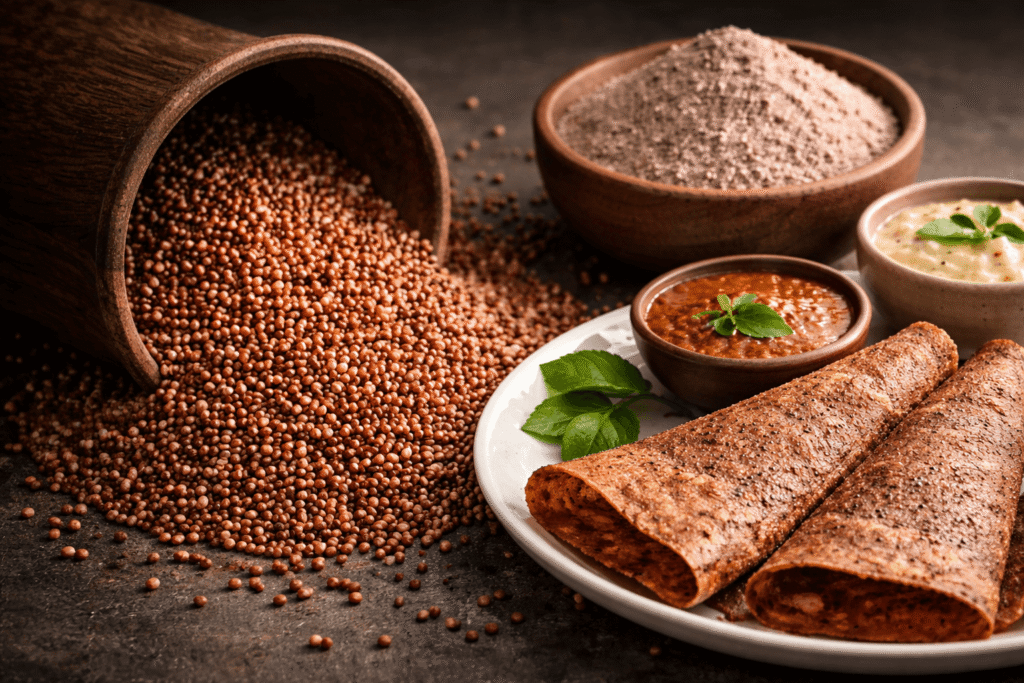
Most of us know Ragi as that brick-red or dark brown flour. However, Ragi actually comes in a few varieties, ranging from white to red to brown to almost black. The red/brown variety is the most commercially available and is packed with phenolic compounds (antioxidants), which is part of why it’s so good for you.
The Name Game: Ragi Around the World
You might know it as Ragi, but if you travel 500 kilometers in any direction in India, the name changes. This grain is a chameleon.
As an SEO professional, I see people searching for these terms constantly, not realizing they are all looking for the same thing. To clear the air, here is a breakdown of what Finger Millet is called across different regions:
| Region / Language | Name |
| English | Finger Millet, African Millet |
| Hindi | Mandua / Nachni |
| Kannada | Ragi |
| Tamil | Kelvaragu / Keppai |
| Telugu | Ragulu |
| Malayalam | Panji Pullu / Koovaraku |
| Marathi | Nachni |
| Oriya | Mandia |
| Punjabi | Mandhuka |
| Ethiopia | Dagussa / Bulo |
Pro Tip: If you see a recipe calling for Nachni flour, don’t panic. It’s just Ragi with a Marathi accent.
A Trip Back in Time: History & Origins
We tend to think of Ragi as a quintessentially Indian “ancient grain,” but its passport actually says Ethiopia.
Finger millet was domesticated in the highlands of East Africa (specifically Ethiopia and Uganda) about 5,000 years ago. It didn’t stay there, though. This hardy little grain traveled across the ocean and arrived in India around 3,000 years ago.
Archaeologists have found evidence of Ragi at the Hallur site in Karnataka dating back to the Iron Age. It wasn’t just a random weed; it was a staple. Ancient civilizations loved Ragi for a very logical reason: it doesn’t spoil.
Ragi is famously resistant to pests during storage. In the past, when famine was a real threat and refrigerators didn’t exist, families would store Ragi in underground pits. It could stay edible for years. It was the ultimate survival food.
The Nutrition Profile: Why It Matters
Okay, this is the part where we look at the numbers. Why does every nutritionist seem to have a crush on Ragi?
It usually comes down to one word: Calcium.
If you compare Ragi to our modern staples like Rice and Wheat, the difference is frankly embarrassing for the other grains. Here is a snapshot of the nutritional value per 100g:
| Nutrient | Ragi (Finger Millet) | White Rice | Wheat |
| Calcium (mg) | 344 | 10 | 41 |
| Iron (mg) | 3.9 | 0.7 | 3.9 |
| Fiber (g) | 3.6 – 11.5 | 0.2 | 2.5 |
| Protein (g) | 7.3 | 6.8 | 11.8 |
(Note: Values can vary slightly based on soil and variety, but the ratios remain consistent)
The “Calcium Bomb”
Look at that Calcium row again. Ragi has roughly 10 times more calcium than rice and 3 times more than milk. This makes it a non-negotiable superfood for:
- Growing kids: Bones need building blocks.
- Women over 30: Bone density starts dropping, and Ragi helps hit the brakes on that process.
- Vegans: If you don’t do dairy, Ragi is your best friend.
5 Reasons Ragi Matters for Your Health
At Mekitt, we believe in accuracy over assumptions. I am not a doctor, and this isn’t a prescription. However, research consistently highlights specific benefits of including this grain in your diet.
1. The Diabetes Defender
Ragi is a favorite among diabetologists. Why? Because it contains high levels of dietary fiber and polyphenols. Unlike polished white rice which spikes your blood sugar like a rollercoaster, Ragi digests slowly. It has a lower glycemic response, meaning it keeps your sugar levels relatively stable rather than sending them through the roof.
2. The “Gluten-Free” OG
Long before “Gluten-Free” became a marketing buzzword slapped on everything from water to soap, Ragi was naturally gluten-free. For people with Celiac disease or gluten sensitivity, Ragi acts as a perfect alternative to wheat for making rotis and breads.
3. Anemia Fighter
Iron deficiency is massive in India. Ragi is a natural source of iron. But here is the trick: simply eating Ragi isn’t enough. Sprouting the Ragi grain (letting it germinate) increases the Vitamin C content, which helps your body absorb that iron much more effectively.
4. Natural Relaxant
This is a lesser-known fact. Ragi contains an amino acid called Tryptophan. You might have heard of this in the context of Thanksgiving turkeys making people sleepy. Tryptophan is a precursor to Serotonin (the happy hormone), which can help manage stress and potentially aid in relaxation and sleep.
5. It Cools You Down
In Ayurveda and traditional Indian medicine, Ragi is considered a “cooling” food. That is why you will see hard-working farmers in the scorching heat of Karnataka eating Ragi Mudde (Ragi balls). It helps maintain body temperature and provides sustained energy without the heaviness of other grains.
Regional Usage: How Do People Actually Eat This?
If you try to eat raw Ragi flour, you are going to have a bad time. It needs to be cooked, and different cultures have perfected different methods.
1. The Powerhouse: Ragi Mudde (Karnataka)
If you visit rural Karnataka, this is religion. Ragi Mudde are dense, steam-cooked balls of ragi flour and water. They are not chewed; they are swallowed in small chunks, usually dipped in a spicy Sambar or chicken curry. It is designed to digest slowly, keeping farmers full from sunrise to sunset.
2. The Comfort Food: Ragi Koozh (Tamil Nadu)
In Tamil Nadu, Koozh is a fermented porridge. It’s tangy, cooling, and often sold by street vendors in earthen pots during the hot summer months. It’s basically the original probiotic smoothie.
3. The Flatbread: Nachni Bhakri (Maharashtra)
Similar to a wheat roti but earthier and slightly coarser. It’s often eaten with Thecha (a spicy chili garlic paste). It’s rustic, humble, and incredibly healthy.
4. The Modern Twist
Today, you don’t have to stick to porridge. You can find Ragi in:
- Cookies and Biscuits: (Watch the sugar content, though!)
- Dosa Batter: Mixing Ragi into standard dosa batter makes it crispier and browner.
- Malt/Health Drinks: The classic “health mix” for kids.
Why Ragi Matters for the Planet (Sustainability)
We talk a lot about what food does to our body, but what about what it does to the earth?
Ragi is a Climate-Smart Crop.
- Drought Resistant: It can survive on very little rainfall (around 500mm). While rice is thirsty and demands standing water, Ragi sips moisture conservatively.
- Hardy: It grows in poor soil where wheat would fail.
- Pest Resistant: It requires very few chemical pesticides compared to other commercial crops.
By eating Ragi, you aren’t just helping your bones; you are supporting a sustainable farming model that saves water. That is a win-win.
A Note on Safety: Who Should Be Careful?
Transparency is a core value here at Mekitt. Ragi is amazing, but it isn’t perfect for everyone.
- Kidney Issues: Ragi is high in Oxalates. If you are prone to kidney stones, doctors usually advise limiting oxalate-rich foods. You don’t have to ban it, but moderation is key.
- Thyroid Issues: Millets contain goitrogens, which can interfere with iodine absorption if consumed in massive quantities. However, cooking the millet (which you always should) largely neutralizes this effect.
Always consult a qualified nutritionist or healthcare professional for personal medical concerns.
Final Thoughts from Mekitt
Ragi isn’t just a “poor man’s grain” anymore, and it isn’t just a trend for the wealthy wellness crowd either. It is a bridge between the past and the future of food. It is resilient, nutritious, and when cooked right, delicious.
My goal with Mekitt is to make sure you have the clear, research-backed information you need to make these choices. Whether you start with a simple Ragi Dosa or go full traditional with Ragi Mudde, you are doing something good for yourself.So, what’s your next step? Next time you are at the grocery store, grab a small pack of Ragi flour. Don’t overthink it. Replace just one meal next week with a Ragi-based dish. Your body (and your grandmother) will thank you.