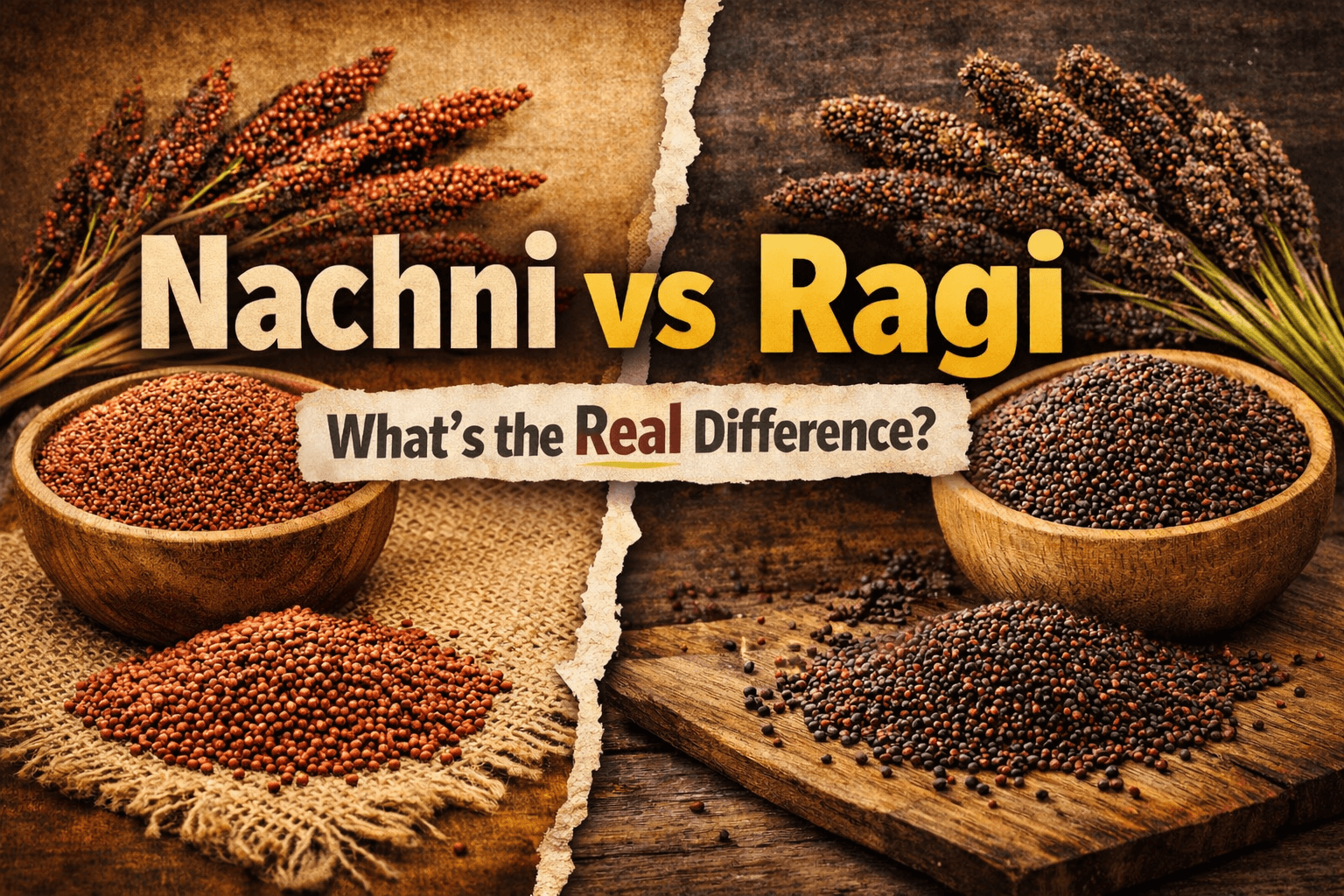
Ever stood in the grocery aisle, holding a packet of “Nachni Satva” in one hand and “Ragi Flour” in the other, wondering if you’re about to buy two completely different things? You aren’t alone. It is one of the most common confusion points in Indian kitchens.
We love our millets, but we also love giving them a dozen different names depending on which state highway we’re driving on.
So, let’s settle the debate immediately, clear up the regional confusion, and dive deep into why this humble grain is taking over the global health food scene.
The Short Answer: Are Nachni and Ragi the Same?
Yes. Absolutely, 100% yes.
Nachni and Ragi are biologically the exact same grain. They are both Finger Millet (Eleusine coracana).
Think of it like this: It’s like the difference between calling someone “Robert” in the office and “Bob” at the barbecue. Same person, same DNA, just a different nickname depending on who is doing the talking.
- Ragi: This is the name commonly used in South India (especially Karnataka) and widely adopted in English-speaking health circles.
- Nachni: This is the name used primarily in Maharashtra and Gujarat.
If you are following a recipe that calls for Ragi flour, and you only have Nachni flour in your pantry, go ahead and use it. You won’t ruin the dish.
Why the Confusion Exists (It’s Not Just You)
If they are the same thing, why do we have a “Versus” battle in our heads? The confusion usually stems from three specific areas: Packaging, Regional Cuisine, and Processing.
1. The Labeling Game
In India, brands often localize their packaging. If you buy a packet of flour in Mumbai, the bold letters will likely say “Nachni Atta.” If you buy that same brand’s packet in Bengaluru, it will say “Ragi Flour.”
When these products migrate—say, a Maharashtra-based brand starts selling on Amazon India—you might see “Nachni” listed next to a competitor selling “Ragi,” leading you to believe they are distinct grains.
2. Culinary Context
While the grain is the same, how we eat it changes the name we associate with it.
- When people hear Ragi, they often think of Ragi Mudde (balls) or Ragi Dosa.
- When people hear Nachni, they think of Nachni Bhakri (flatbread) or Satva (pudding for toddlers).
Your brain categorizes them as “different” because the texture of the final dish is different, even though the raw ingredient is identical.
3. Color Varieties
Finger millet comes in shades ranging from reddish-brown to almost white. Sometimes, a consumer buys a darker “Ragi” flour and later buys a lighter “Nachni” flour, assuming the color difference means a species difference. It doesn’t. That’s just nature being diverse.
The Many Names of Finger Millet: A Regional Dictionary
To make sure you never get confused again, let’s map this grain across India. This is crucial for anyone looking up recipes from different states.
| Region / Language | Name Used |
| English / Global | Finger Millet |
| Scientific Name | Eleusine coracana |
| Kannada (Karnataka) | Ragi |
| Hindi | Mandua / Ragi |
| Marathi (Maharashtra) | Nachni |
| Gujarati (Gujarat) | Nachni / Nagli |
| Tamil (Tamil Nadu) | Kezhvaragu (often shortened to Keppai) |
| Telugu (Andhra/Telangana) | Ragulu |
| Malayalam (Kerala) | Panjipullu |
| Odia (Odisha) | Mandia |
| Garhwali (Uttarakhand) | Koda |
Note for Travelers: If you are trekking in the Himalayas (Uttarakhand) and they serve you “Koda ki Roti,” you are eating Nachni/Ragi. It’s a staple there too!
Nutritional Profile: Why We Should Eat It (Regardless of the Name)
Whether you call it Nachni or Ragi, the nutritional profile remains a powerhouse. This isn’t just a “diet trend”; this is a survival crop that has fed civilizations for centuries.
Here is what makes this grain special. (Remember, as stated in our About Us, we provide this for educational purposes, not as medical advice ).
1. The Calcium Champion
This is the headline feature. Finger Millet has one of the highest calcium contents of any grain—significantly higher than rice, wheat, or corn.
- Why it matters: It is fantastic for growing children (bone development) and older adults (bone density maintenance).
- Fact Check: According to the National Institute of Nutrition (NIN), India, Ragi contains approximately 344mg of Calcium per 100g. Compare that to rice, which has drastically less.
2. Iron-Clad Health
Anemia is a massive issue globally. Nachni is a good source of natural iron. However, here is the SEO pro tip for your diet: eat it with Vitamin C (like a squeeze of lemon or with a side of veggies) to help your body absorb that iron better.
3. The “Slow Carb” Advantage
Diabetics often fear grains. But Ragi is what we call a complex carbohydrate with a decent amount of fiber.
- The Logic: It digests slowly. Instead of spiking your blood sugar like a rocket (looking at you, white bread), it releases energy steadily. It keeps you full longer, which stops you from snacking on junk an hour later.
4. Naturally Gluten-Free
For the celiac community or those with gluten sensitivity, Nachni is a lifesaver. It is naturally free of gluten, making it a great wheat alternative for baking cookies, breads, and cakes.
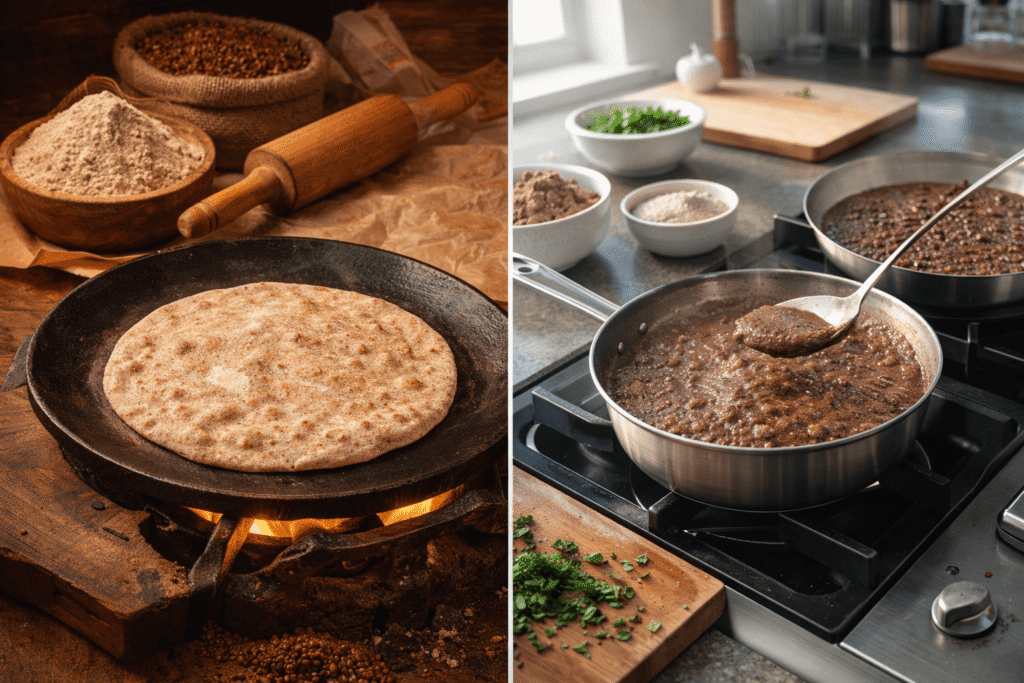
Cooking with It: Nachni vs. Ragi in the Kitchen
This is where the culture war happens—not on the farm, but on the plate. Let’s look at how the “name” changes the “game.”
The “Nachni” Style (West India)
In Maharashtra, Nachni Bhakri is the king. It is a rustic, unleavened flatbread made by patting the dough by hand (not rolling it with a pin). It is traditionally eaten with:
- Thecha: A spicy chili-garlic crush.
- Pithla: A gram flour curry. This is hardy, farmer food. It gives you the strength to work the fields (or survive a long commute in Mumbai traffic).
Nachni Satva is another variation—a sprouted flour pudding given to babies or people recovering from illness. It’s considered one of the most digestible foods available.
The “Ragi” Style (South India)
In Karnataka, the Ragi Mudde is legendary. This isn’t a bread; it’s a dense ball made by cooking ragi flour with water until it forms a dough. You don’t chew Mudde; you swallow small balls of it dipped in spicy Sambar or Chicken curry.
- Fun Fact: If you try to chew Ragi Mudde, it sticks to the roof of your mouth. The “swallow” technique is an art form!
Ragi Malt (or Ragi Ambli) is a popular summer drink, often mixed with buttermilk and onions to cool the body down.
Common Myths Busted
Let’s use some logic to dismantle the fake news floating around WhatsApp universities regarding this grain.
Myth 1: “Ragi is warming, Nachni is cooling.” Fact: They are the same grain! However, the ingredient you pair it with changes the thermal effect on the body.
- Eat it with buttermilk (Ambli)? It’s cooling.
- Eat it as a hot porridge with ghee in winter? It keeps you warm. The grain itself is neutral to warm, but your recipe dictates the effect.
Myth 2: “It’s only for babies and diabetics.” Fact: While it is great for them, limiting Ragi to “sick food” is a crime against taste. Have you tried Ragi chocolate cookies? Or Ragi nachos? (Yes, “Nachni Nachos” is a pun waiting to happen). It has a nutty, earthy flavor that pairs beautifully with cocoa and jaggery.
Myth 3: “Processing changes the name.” Fact: Some people think “Nachni” refers to the whole grain and “Ragi” refers to the flour. Incorrect. Both words apply to the grain, the flour, and the plant.
Why the World Loves Millets Right Now
You might wonder why we are writing about this now. Millets are having a moment. The United Nations declared 2023 the International Year of Millets, and the buzz hasn’t died down.
From an environmental perspective, Finger Millet is a superhero:
- Drought Resistant: It grows with very little water compared to rice.
- Pest Resistant: It rarely needs chemical pesticides because it’s naturally hardy.
- Long Shelf Life: The grains can be stored for years without spoiling, making it an excellent famine reserve crop.
By choosing Nachni/Ragi, you aren’t just helping your health; you are supporting sustainable, climate-smart agriculture.
Conclusion: Use Whatever Name You Like, Just Eat It
So, to wrap up this investigation for our Mekitt.com readers:
- Is Nachni the same as Ragi? Yes.
- Can I swap them in recipes? Yes.
- Should I include it in my diet? Absolutely.
Whether you call it Nachni, Ragi, Mandua, or Finger Millet, the benefits remain the same. Don’t let the regional labeling confuse you. Grab that packet, check the expiration date, and start cooking.
A Note from Megha: At Mekitt.com, we believe in accuracy over assumptions. We hope this clears up the aisle confusion for you. If you have a favorite Ragi or Nachni recipe, or if you call this grain something totally different in your hometown, we’d love to hear about it!